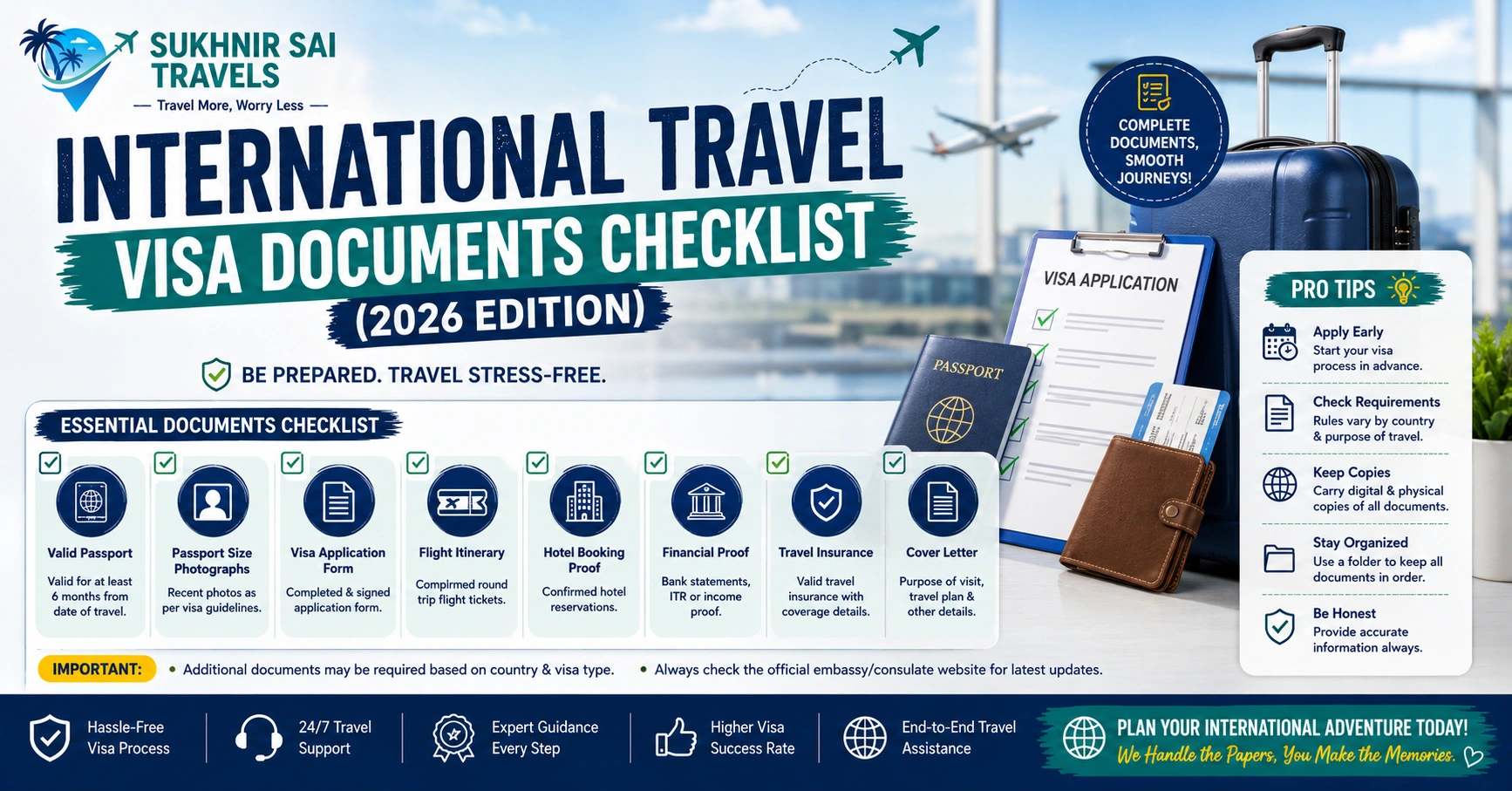
International Travel Visa Documents Checklist (2026 Edition)
Nearly every visa rejection or delay traces back to the same handful of paperwork problems — a missing bank seal, a passport with too little validity left, an inconsistency between two documents. None of these require expert knowledge to avoid; they just require checking the right things before you submit. This is a complete, practical checklist covering what almost every visa application needs, organised so you can actually use it while gathering your documents rather than just reading through it once.
The Universal Checklist: What Nearly Every Visa Needs
Regardless of destination, these documents form the backbone of almost any visa application:
- Passport valid for at least 6 months beyond your intended return date, with at least 2 blank visa pages
- Passport-size photographs, typically 2 recent copies, white background — exact size requirements vary by country, so confirm before printing
- Completed visa application form, signed and dated
- Proof of travel dates — a confirmed or refundable flight itinerary
- Proof of accommodation — hotel bookings or a formal invitation letter if staying with someone
- Proof of financial means — recent bank statements, typically 3–6 months, often required with an official bank seal
- Travel insurance, particularly mandatory for Schengen applications and increasingly requested for other destinations
- Cover letter outlining your travel purpose, itinerary, and duration
Almost every rejection traces back to one of these being missing, expired, inconsistent, or improperly formatted — which is exactly why this list is worth treating as non-negotiable rather than a rough guide.
Documents Checklist by Traveller Type
For Employed Travellers
- Employment verification letter (confirming role, salary, and approved leave dates)
- Latest 3 months' salary slips
- Income Tax Returns (ITR) for the last 2–3 years
- Leave approval letter from your employer, if applying during work days
For Self-Employed or Business Owners
- Business registration certificate or GST registration
- Company bank statements (in addition to personal statements)
- ITR for the last 2–3 years
- A brief letter on company letterhead describing your business and the purpose of travel
For Students
- Bonafide certificate or enrolment proof from your educational institution
- No-objection certificate (NOC) from your institution, if travelling during term time
- Sponsor's financial documents, if a parent or guardian is funding the trip, along with a sponsorship letter and their relationship proof
For Retired Travellers
- Pension statements or proof of retirement funds
- Bank statements showing consistent, stable balances
- Property documents, if available, as additional proof of ties to India
For Children Travelling Internationally
- Birth certificate
- Passport (children need their own individual passport and, in most cases, their own visa)
- If travelling with one parent: a notarised consent letter from the other parent
- If travelling with neither parent: notarised consent letters from both parents, plus the accompanying adult's ID
Documents Checklist by Visa Type
Tourist Visa
- Detailed day-by-day itinerary
- Confirmed return flight ticket
- Hotel bookings for the full duration of stay
- Proof of sufficient funds for the trip length
Business Visa
- Invitation letter from the host company abroad
- Letter from your employer authorising the business trip
- Details of the business event, meeting, or exhibition being attended
- Proof of your company's financial standing, where requested
Visit Visa (Visiting Family or Friends)
- Invitation letter from your host, including their residency proof
- Proof of your relationship to the host (if visiting family)
- Host's financial documents, if they're sponsoring part of your stay
Student Visa
- Offer or admission letter from the educational institution
- Proof of tuition fee payment or fee structure
- Academic transcripts and certificates
- Proof of funds covering tuition and living expenses, or a scholarship/sponsorship letter
Employment Visa
- Signed job offer letter or employment contract
- Educational and professional certificates, as required by the employer or destination country
- Medical fitness certificate, where required (commonly requested for Gulf countries)
Region-Specific Document Notes
Schengen Countries (Europe)
Travel insurance with a minimum of €30,000 medical coverage is mandatory, and consulates weigh proof of ties to India — property documents, stable employment, prior travel history — more heavily than for many other regions. For the full breakdown, see our Schengen visa guide.
UAE (Dubai)
Most tourist visa applications today are processed entirely online, without an embassy visit or biometric appointment, but proof of return travel and accommodation is still commonly requested at immigration even if not mandatory at the application stage. See our Dubai visa guide for current fees and process.
Southeast Asia (Thailand, Vietnam, Indonesia)
Entry rules here shift more often than in most regions — Thailand's visa-free stay duration, for instance, has changed more than once in 2026. Always verify the current rule close to your travel date rather than relying on older articles, and keep proof of funds and onward travel accessible even for visa-free or e-visa entries.
Gulf Countries (Beyond UAE)
Employment and business visas for Gulf countries often require a medical fitness certificate and additional employer documentation beyond the universal checklist — start gathering these earlier than you would for a tourist visa, since medical appointments and employer paperwork both take time.
Common Mistakes That Delay or Reject Applications
- Passport validity under 6 months — one of the most frequent, entirely avoidable issues across every visa type.
- Unstamped or unsealed bank statements — many consulates specifically require an official bank seal, not just a printed statement.
- Mismatched details — names, dates, or addresses that differ across your passport, bank statements, and application form.
- Booking non-refundable flights before visa approval — doesn't cause rejection directly, but adds real financial risk if the application doesn't go through.
- Outdated or generic cover letters — a cover letter that doesn't clearly state your specific itinerary and purpose reads as an afterthought to visa officers who review hundreds of applications.
- Applying too close to your travel date, leaving no buffer if a document needs correcting or resubmitting.
- Assuming visa-free or e-visa entry means no documents needed — even visa-free destinations often expect proof of funds and onward travel at immigration.
How Far in Advance to Start Gathering Documents
|
Visa Type |
Recommended Lead Time |
|
Simple e-visa / visa-on-arrival (Bali, Thailand, Sri Lanka) |
1–2 weeks |
|
Standard tourist visa (Dubai, most of Southeast Asia) |
3–4 weeks |
|
Schengen visa |
6–8 weeks |
|
Student visa |
3–6 months |
|
Employment visa |
2–4 months |
Bank statements, ITRs, and employment letters often take longer to arrange than travellers expect — starting the financial document gathering early is usually the single biggest time-saver in the whole process.
FAQs: Visa Documents Checklist
1. What is the most commonly missed visa document?
A bank statement with an official seal or stamp — many travellers submit a printed statement without realising most consulates specifically require the bank's seal, not just the transaction history.
2. How much passport validity do I need for a visa?
Most countries require at least 6 months of validity remaining beyond your intended return date, along with at least 2 blank visa pages.
3. Do I need travel insurance for every visa application?
It's mandatory for Schengen visas (minimum €30,000 medical coverage) and increasingly requested for other destinations, even when not strictly required — it's worth having regardless of destination.
4. What documents do children need for international travel?
Their own passport (and in most cases, their own visa), a birth certificate, and — if travelling with only one parent or another adult — a notarised consent letter from the non-travelling parent(s).
5. How early should I start gathering visa documents?
For a simple e-visa or visa-on-arrival, 1–2 weeks is usually enough. For a Schengen visa, start 6–8 weeks ahead; for student or employment visas, 2–6 months, given how long some supporting documents take to arrange.
6. Can Sukhnir Sai Travels help me prepare my visa documents?
Yes — we review your documents against the specific requirements for your destination before submission, which is often what makes the difference between a smooth approval and an avoidable delay.
Don't Leave Your Visa Application to Guesswork
A single missing seal or an outdated cover letter can cost you both time and a non-refundable visa fee. Our team can review your documents against your specific destination's requirements before you submit.
