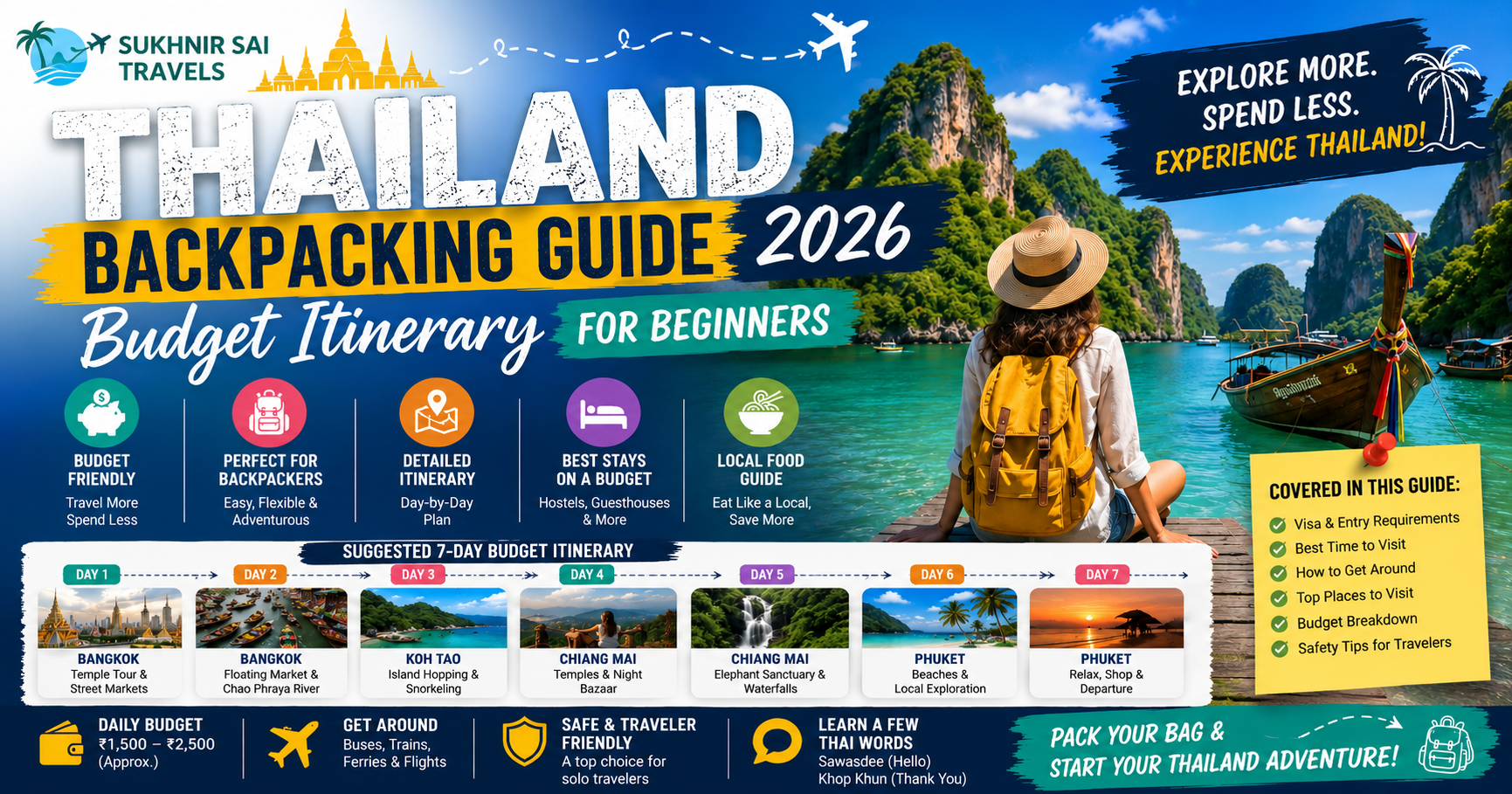
Thailand Backpacking Guide 2026: Budget Itinerary for Beginners
Thailand is where most Indian travellers take their first real backpacking trip, and for good reason — it's cheap, the entry rules are simple, hostels and night trains make getting around easy without a fixed plan, and the country packs temples, jungle, and islands into a space small enough to cover in under two weeks. This guide walks through everything a first-time backpacker needs: entry requirements, how much it actually costs, the best backpacker routes, and a ready 10-day itinerary you can adapt to your own dates.
Why Thailand Is the Best First Backpacking Trip
Thailand solves most of the problems that make a first solo or budget trip stressful. Hostels are everywhere and genuinely social, street food is safe and excellent, English is widely understood in tourist areas, and the backpacker trail is well-worn enough that you're never more than a conversation away from other travellers doing the same route. It's also short-haul from India — around 4–5 hours in the air — so you're not burning a full day of your trip just getting there.
Thailand Entry Rules for Indians in 2026
Indian passport holders currently get visa-free entry to Thailand for tourism, which is a major part of why it's such an easy first backpacking destination. However, the exact stay duration has shifted more than once in 2026, so it's worth confirming the current rule close to your travel date rather than relying on older articles.
What's Confirmed as of Mid-2026
- No visa fee, no advance application required for Indian tourists on a standard holiday.
- You must complete the Thailand Digital Arrival Card (TDAC) online, free of charge, within 72 hours before arrival — this replaced the old paper arrival card and applies to all foreign nationals.
- Thailand's Tourism Minister confirmed in July 2026 that visa-free entry for Indian passport holders continues, though the maximum stay allowed under the scheme has been a point of change through the year — it has been reported at both 60 days and, more recently, 30 days depending on the announcement. For a standard 10–14 day backpacking trip, this shift makes no practical difference, but if you're planning to stay longer, verify the current limit on the official Royal Thai Embassy or Tourism Authority of Thailand channels before booking.
- Immigration officers may ask for proof of funds (around THB 20,000 per person) and evidence of onward travel, so keep a return or onward ticket and some financial proof accessible.
- If you do overstay, Thailand charges a fine of THB 500 per day (capped around THB 20,000), and extensions are possible at a local immigration office before your permitted stay expires.
Best Time for a Thailand Backpacking Trip
November to February (cool, dry season) is the best window for backpacking — comfortable temperatures, minimal rain, and ideal conditions for both jungle trekking in the north and island-hopping in the south.
March to May gets hot and humid, especially inland, though it's still workable if you lean toward the islands and don't mind the heat.
June to October is the rainy season — cheaper flights and fewer crowds, but expect short, heavy downpours, and some island boat routes can be affected by rough seas.
Best Backpacker Routes in Thailand
Route 1: The Classic North-to-South (10–14 days)
Bangkok → Chiang Mai → Pai → back to Bangkok → fly south to Krabi or Phuket → island-hop (Koh Phi Phi, Koh Lanta). This is the most popular first-timer route, mixing city, mountains, and islands without excessive backtracking.
Route 2: Islands-Only (7–10 days)
Bangkok (2 days) → Koh Tao (diving/snorkelling) → Koh Phangan → Koh Samui, using overnight ferries between islands. Best if you have limited time and want to prioritise beaches and diving over temples and jungle.
Route 3: North-Only Slow Travel (10 days)
Bangkok → Chiang Mai → Pai → Chiang Rai → back to Chiang Mai, at a much slower pace with more time in each town. Better suited to travellers who prefer trekking, cooking classes, and temple-hopping over beach time.
Must-Visit Places for First-Time Backpackers
Bangkok
Almost every route starts or ends here. Khao San Road is the classic backpacker hub for cheap hostels and nightlife, while the Grand Palace, Wat Arun, and the floating markets are worth a couple of days before you move on.
Chiang Mai
Thailand's backpacker and digital-nomad capital in the north — Old City temples, a genuinely excellent night market, ethical elephant sanctuaries (choose ones that don't offer elephant riding), and jungle trekking day trips.
Pai
A small mountain town roughly 3–4 hours from Chiang Mai by a famously winding road, known for its laid-back vibe, waterfalls, hot springs, and a strip of live-music bars that make it a common "just one more day" stop for backpackers.
Krabi & Railay Beach
Dramatic limestone cliffs, rock climbing, and boat access to some of Thailand's most photographed beaches — Railay is boat-access-only, which keeps it quieter than more built-up beach towns.
Koh Phi Phi
Famous for Maya Bay and a lively backpacker party scene, though it's also one of the more expensive and crowded islands — good for a couple of nights rather than a long stay if budget matters.
Koh Lanta
A quieter, less party-oriented island than Phi Phi, with long beaches and a slower pace — a good counterbalance if you want to decompress after Bangkok and Phi Phi.
Koh Tao
The go-to island for affordable diving certifications (PADI Open Water courses here are among the cheapest in the world) and a solid but calmer nightlife scene than Phi Phi or Phangan.
10-Day Thailand Backpacking Itinerary
Day 1–2: Bangkok
- Arrive, settle into a Khao San Road-area hostel
- Grand Palace, Wat Arun, Wat Pho
- Evening street food crawl and a rooftop bar
Day 3: Fly or overnight train to Chiang Mai
- Overnight sleeper train is the classic budget-backpacker move — cheaper than flying and saves a night's accommodation
- Arrive Chiang Mai, explore the Old City temples
Day 4: Chiang Mai
- Ethical elephant sanctuary day trip
- Evening at the Sunday Walking Street night market
Day 5–6: Pai
- Minivan to Pai (3–4 hours)
- Waterfalls, hot springs, Pai Canyon at sunset
- Evening at one of Pai's live-music bars
Day 7: Back to Bangkok, fly south to Krabi
- Return to Chiang Mai, fly to Bangkok, connect to Krabi
- Settle into Ao Nang or Railay Beach
Day 8: Krabi & Railay
- Boat to Railay Beach, rock climbing or just beach time
- Sunset at Railay West
Day 9: Island hop to Koh Phi Phi or Koh Lanta
- Ferry to your chosen island
- Snorkelling or diving, beach time
Day 10: Departure
- Fly out from Krabi or Phuket, or connect back via Bangkok depending on your international flight
This itinerary assumes budget-conscious overland and ferry travel between stops; if you have less time, cutting Pai and going straight from Chiang Mai to the islands turns this into a comfortable 7-day trip.
Thailand Backpacking Budget (2026)
Here's a realistic daily and total cost breakdown for a 10-day solo backpacking trip.
Daily Costs (Per Person)
|
Category |
Budget Level |
Approx. Cost/Day |
|
Hostel dorm bed |
Basic to mid-range |
₹500 – ₹1,200 |
|
Street food / local meals |
3 meals/day |
₹600 – ₹1,000 |
|
Local transport |
Songthaews, buses, ferries |
₹300 – ₹600 |
|
Activities |
Temples, treks, snorkelling (averaged) |
₹500 – ₹1,500 |
|
Daily total |
₹1,900 – ₹4,300 |
10-Day Total Estimate (Per Person, Excluding Flights)
- Shoestring budget: ₹19,000 – ₹25,000
- Comfortable backpacker budget: ₹30,000 – ₹43,000
Add-On Costs
- International flights (India–Bangkok round trip): ₹18,000 – ₹35,000, depending on season and how far ahead you book
- Domestic flights (Chiang Mai–Krabi or similar): ₹2,500 – ₹5,000 per sector
- Overnight train (Bangkok–Chiang Mai): ₹700 – ₹1,800 depending on class
- PADI diving certification (Koh Tao): ₹18,000 – ₹22,000, if you choose to add this
Money-Saving Tips
- Book overnight trains and buses instead of flights for the Bangkok–Chiang Mai leg — you save both a travel day and a night's accommodation.
- Eat where locals eat — street food stalls and local markets are both cheaper and often better than restaurants aimed at tourists.
- Travel in the November–February cool season for the best balance of good weather and manageable prices; June–October is cheaper but rainier.
- Book island ferries a day or two ahead rather than same-day, since prices tend to rise closer to departure.
- Check our International Tours if you'd rather have flights, key stays, and island transfers pre-arranged while keeping the day-to-day exploring flexible.
What to Pack for Backpacking Thailand
- A proper backpack (40–55L) rather than a suitcase — much easier on trains, tuk-tuks, and hostel stairs
- Lightweight, quick-dry clothing and a light rain jacket for sudden downpours
- Flip-flops or sandals for beaches, plus one sturdy pair of shoes for trekking
- A padlock for hostel lockers
- A basic first-aid kit, rehydration salts, and any regular medication
- Power adapter (Thailand uses Type A/B/C/O plugs)
- A copy of your passport and TDAC confirmation saved offline, in addition to the originals
Insider Tips for First-Time Backpackers
- Complete the TDAC online within 72 hours of arrival — don't leave it for the airport, as queues for travellers who haven't filled it in advance can be long.
- Negotiate tuk-tuk fares before getting in; metered taxis in Bangkok are actually often cheaper if the driver agrees to use the meter.
- Keep small baht notes handy for street food and songthaews — many vendors can't break large bills.
- Join a free hostel-organised pub crawl or walking tour on your first night in a new city — it's the fastest way to meet other travellers heading the same direction.
- Don't overpack your itinerary — Thailand rewards slowing down in one or two places rather than rushing through five.
FAQs: Thailand Backpacking Guide
1. Do Indians need a visa to backpack in Thailand?
No advance visa is required for tourism — Indian passport holders get visa-free entry, though you must complete the free Thailand Digital Arrival Card (TDAC) online before arrival. Stay-duration rules have shifted during 2026, so confirm the current limit before booking if you're planning a longer trip.
2. How much does a 10-day Thailand backpacking trip cost?
Excluding international flights, a 10-day trip typically costs ₹19,000–25,000 on a shoestring budget or ₹30,000–43,000 for a more comfortable backpacking pace, covering hostels, food, local transport, and activities.
3. Is Thailand safe for first-time solo backpackers?
Yes — Thailand is one of the most solo-traveller-friendly countries in Southeast Asia, with a well-established hostel network, widely spoken English in tourist areas, and a well-worn backpacker trail that makes meeting other travellers easy.
4. What's the best backpacking route for first-timers?
The classic Bangkok–Chiang Mai–Pai–islands route is the most popular first-time route, covering city, mountains, and beaches without excessive backtracking. Islands-only or north-only routes work well if you have less time or a specific focus.
5. What is the best time of year to backpack Thailand?
November to February offers the most comfortable weather for both trekking in the north and island-hopping in the south. June–October is cheaper but comes with more rain.
6. Can Sukhnir Sai Travels help plan a Thailand backpacking trip?
Yes — we can pre-arrange flights, key stays, and island transfers around your chosen route while leaving room for the flexible, day-to-day exploring that makes backpacking trips work.
Plan Your Thailand Trip with Sukhnir Sai Travels
Whether you're backpacking solo or want a few pieces pre-arranged so you're not booking everything on the fly, we can put together a Thailand itinerary that fits your route, budget, and travel style.
