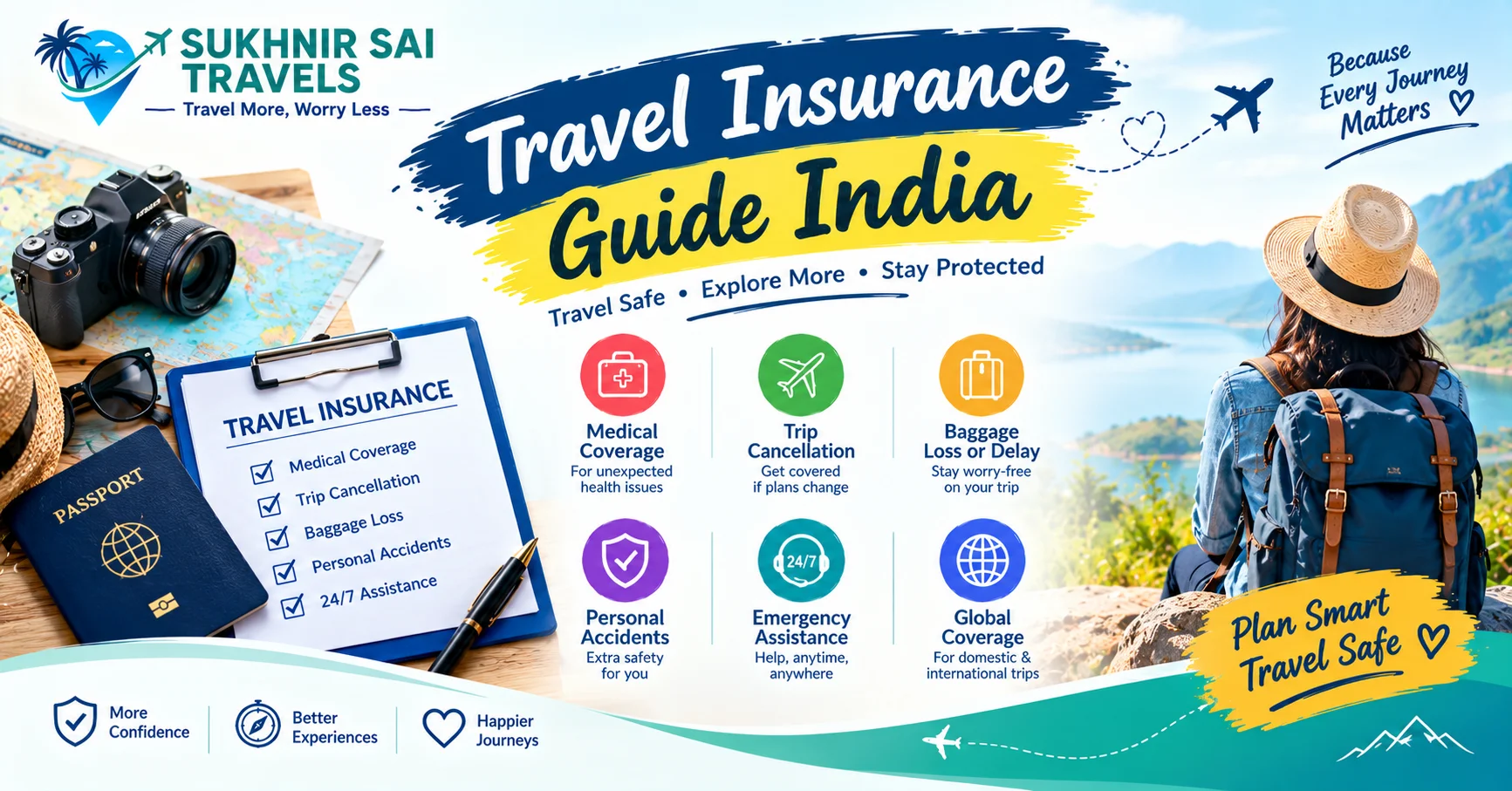
Is Travel Insurance Really Worth It for Domestic and International Journeys?
Yes, for both — but not for the reason most people assume. Claims data from Indian insurers shows travellers file roughly six times as many outpatient claims (a stomach bug, a viral flu, a minor injury) as major hospitalisation claims. It's not the dramatic emergency that usually drains your trip budget — it's the everyday disruption nobody plans for. Domestic policies cost as little as ₹100–500 a trip; international ones are mandatory for several destinations and genuinely cheap insurance against medical bills that can run into lakhs abroad.
Here's a pattern worth noticing: almost every Indian traveller knows travel insurance exists, and most still skip it, especially for domestic trips. That's not ignorance — it's a mismatch between what people imagine insurance is for (a plane crash, a major hospitalisation) and what it actually, statistically, gets used for (a bad case of food poisoning in a town with one pharmacy, a delayed flight that costs you a day of a short trip). Once you see the real claims data, the "do I actually need this" question answers itself fairly quickly.
What Travel Insurance Actually Gets Used For
The biggest myth about travel insurance is that it's mainly protection against rare catastrophes. Recent claims data from one of India's largest insurance aggregators tells a different story: outpatient (OPD) claims — minor illnesses and injuries treated without hospital admission — outnumber major inpatient claims roughly six to one. Hospitalisation costs more per claim, but it's the everyday stomach infection or viral flu that actually disrupts the most trips.
Baggage issues follow a similarly unglamorous pattern. International transit hubs — the big connecting airports most Indian travellers pass through — account for over 14% of all travel insurance claims combined, mostly delayed or lost luggage during connections rather than anything dramatic.
None of this is to say the big-ticket coverage doesn't matter. A broken leg requiring treatment in the US can run past $20,000, and an emergency medical evacuation back to India routinely crosses ₹40 lakh. Those numbers are exactly why insurance exists — but the data suggests you're statistically far more likely to file a claim for a bad stomach bug than a medical evacuation, which is a genuinely useful thing to know when you're deciding whether a "basic" or "comprehensive" plan makes sense for your trip.
Domestic Travel Insurance: The Coverage Most Indians Skip
Here's the part that surprises a lot of people: domestic travel insurance exists, it's inexpensive, and almost nobody buys it, despite the risks of travel within India being genuinely comparable to international risk for certain kinds of trips. IRDAI has standardised domestic travel insurance into a defined set of plan types, with coverage typically running ₹5–10 lakh for hospitalisation following an accident, at a cost of roughly ₹100–500 per trip.
Where this actually matters most: trips to remote or less-accessible parts of India — the Northeast, Ladakh, the Andamans, or high-altitude regions where the nearest major hospital might be hours away. A Kashmir honeymoon built around houseboat stays and mountain drives, for instance, is exactly the kind of trip where a ₹200 domestic policy is cheap insurance against an inconvenient accident turning into a genuinely stressful situation far from major medical infrastructure. The same logic applies to a Jim Corbett family safari trip — remote enough that quick access to serious medical care isn't guaranteed the way it would be in a city.
International Travel Insurance: Increasingly Non-Negotiable
India now sends well over 2.7 crore outbound tourists a year, and overseas medical costs have climbed well past what most travellers expect to pay out of pocket. Beyond the financial argument, a measurable share of destinations now make travel insurance a hard entry requirement, not an optional add-on.
Schengen countries are the clearest example. For a Schengen visa, your insurance must provide at least €30,000 in medical coverage, remain valid for your entire stay including travel dates, cover all Schengen member states, explicitly state Schengen compliance on the certificate, and come from an IRDAI-licensed Indian insurer. Our Schengen visa guide covers the full visa application process if Europe is on your itinerary — but the insurance requirement specifically is where applications most often fall short, since a policy that doesn't explicitly state Schengen compliance can be rejected even if the coverage amount is technically sufficient.
Beyond Schengen, growing geopolitical uncertainty and health-related travel disruptions over the last couple of years have noticeably shifted Indian traveller behaviour — insurance uptake for international trips has grown well ahead of overall outbound travel growth, suggesting more people are treating it as a real safeguard rather than a box to tick for a visa application.
What's New in Travel Insurance Regulation (2026)
IRDAI introduced an Insurance Fraud Monitoring Framework that came into effect in April 2026, requiring insurers to maintain board-level anti-fraud governance and faster incident reporting. For travellers, this is a genuinely positive, if quiet, development — tighter regulatory oversight generally translates to more consistent claims handling across the industry, regardless of which insurer you choose.
Domestic vs. International Travel Insurance: Quick Comparison
| Feature | Domestic Travel Insurance | International Travel Insurance |
|---|---|---|
| Typical cost | ₹100 – ₹500 per trip | Varies by destination, duration, and age |
| Typical coverage | ₹5–10 lakh hospitalisation | Often $50,000–$1,000,000+ medical coverage |
| Mandatory for visa? | No | Yes, for Schengen and several other destinations |
| Most common claim type | Accidental hospitalisation | OPD/minor illness, baggage delay |
| Best suited for | Remote-region domestic trips (hills, Northeast, islands) | Any international trip, especially Europe/US/UK |
How to Actually Choose a Policy
Check the claim settlement ratio, not just the premium. IRDAI publishes claim settlement data for insurers, and this single number tells you more about how a policy will actually behave when you need it than any feature list on a sales page.
Confirm IRDAI registration. Every legitimate travel insurer operating in India carries an IRDAI registration number — a basic but important check, particularly when buying through a lesser-known aggregator or a booking-site add-on.
Match coverage to your actual destination's requirements, not a generic "international plan" — Schengen-bound travellers specifically need a policy that states Schengen compliance; other destinations may have their own minimum coverage thresholds worth confirming before you buy.
Read the exclusions, not just the inclusions. Pre-existing conditions, adventure sports, and certain high-risk destinations are commonly excluded or require an add-on rider — worth checking if your trip involves trekking, diving, or similar activities.
Don't assume your credit card's "complimentary" travel insurance is sufficient. These add-on covers typically carry much lower limits and narrower coverage than a dedicated policy, and are worth checking carefully rather than assuming they match what a standalone plan offers.
FAQs: Travel Insurance in India
1. Is travel insurance really worth it, or is it a waste of money if nothing goes wrong?
It's genuinely worth it for most trips — claims data shows minor, everyday disruptions (illness, baggage delays) are far more common than major emergencies, meaning the "nothing goes wrong" scenario is less likely than people assume, especially on longer or international trips.
2. Do I need travel insurance for domestic trips within India?
It's not mandatory, but it's inexpensive (₹100–500 per trip) and genuinely useful for trips to remote regions — the Northeast, Ladakh, the Andamans, or high-altitude areas — where access to major medical care isn't guaranteed.
3. Which destinations require travel insurance by law?
Schengen countries require it as a visa condition, with specific minimum coverage (€30,000) and compliance requirements. Several other countries strongly recommend or increasingly require proof of insurance at entry, even where it's not strictly mandatory.
4. What does travel insurance typically NOT cover?
Common exclusions include pre-existing medical conditions (unless specifically covered by an add-on), adventure sports without a rider, and travel to certain high-risk regions — always worth checking a policy's exclusions list before assuming broad coverage.
5. How do I know if a travel insurance policy is good?
Check the insurer's IRDAI registration and published claim settlement ratio, confirm the coverage matches your destination's specific requirements (especially for Schengen), and read the exclusions list rather than relying on the headline coverage amount alone.
6. Can Sukhnir Sai Travels help me sort out visa and travel insurance requirements together?
Yes — when we handle visa applications, including for Schengen and other destinations with specific insurance requirements, we can guide you toward a policy that actually meets what the application needs, rather than leaving you to figure out compliance details on your own.
Get Travel Insurance and Visa Guidance Sorted Together
Figuring out exactly what coverage your destination or visa actually requires can be more confusing than it should be. We can help you sort through it as part of your overall trip planning, alongside visa documentation and travel prep.
