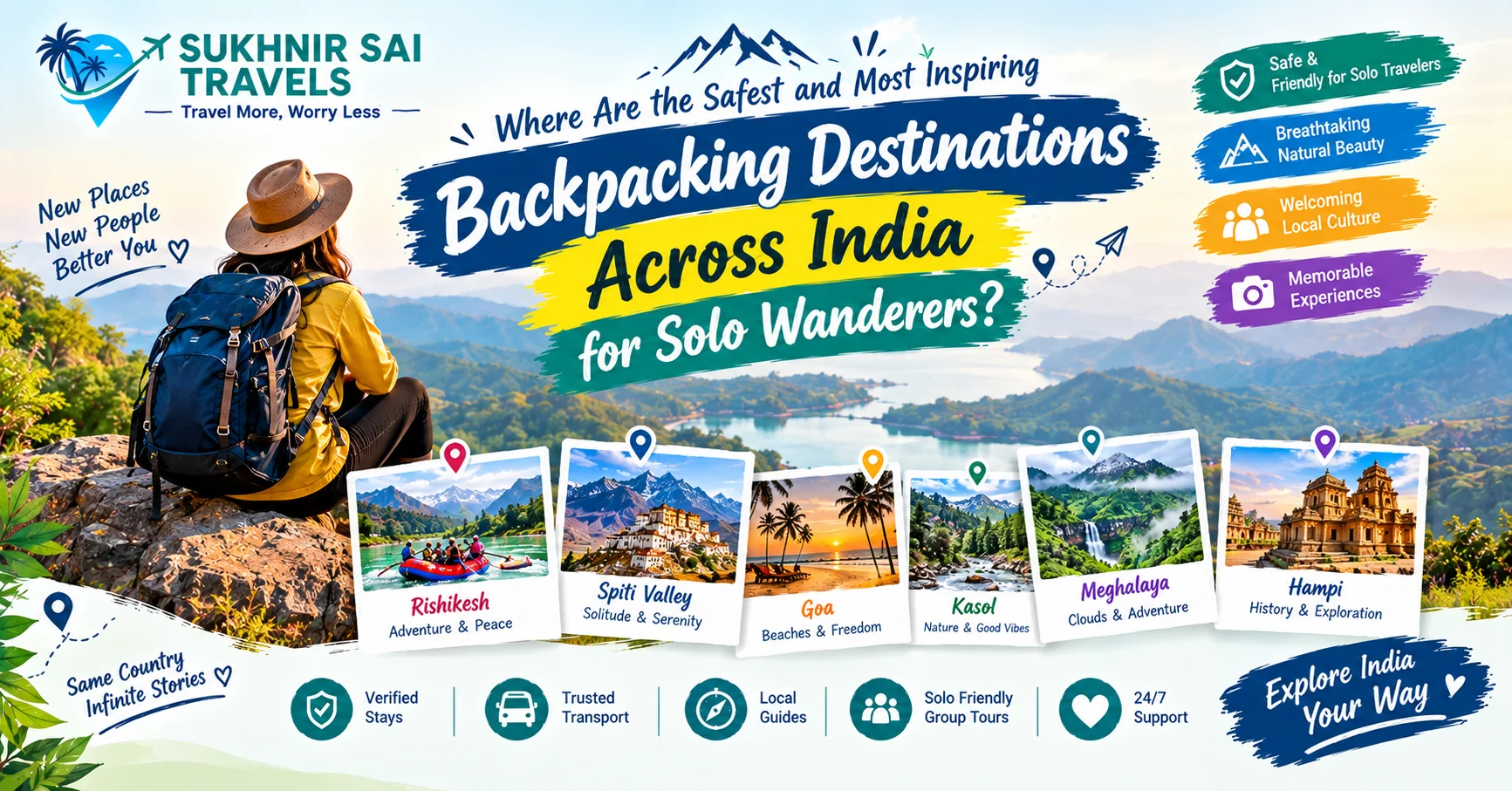
Where Are the Safest and Most Inspiring Backpacking Destinations Across India for Solo Wanderers?
Rishikesh, Hampi, Gokarna, McLeodganj, and Pondicherry consistently top the list for solo backpackers in India — each has an established traveller circuit, affordable hostels, and enough daylight-hours activity that you're never stuck waiting for the day to feel worthwhile. Below is a fuller list of 10, what makes each genuinely good for solo travel (not just scenic), and how to string a few together into a real trip.
India's backpacking scene has matured a lot over the last decade — what used to be a handful of well-known hippie trails is now a genuinely well-connected network of hostels, budget stays, and traveller communities spanning the length of the country. The trick isn't finding a place to backpack; it's picking destinations that are actually set up for solo travel, not just pretty in photos.
What Makes a Destination Genuinely Good for Solo Backpacking
Before the list, worth being specific about what separates a solid solo backpacking destination from one that just looks good on Instagram:
- An established hostel or budget-stay network, which usually comes with other solo travellers to meet and staff used to independent travellers' questions.
- Daylight-heavy activities, so your day has structure without needing a group or a guide.
- Reliable local transport — walkable centres, app-based cabs, or a well-connected local bus/train system.
- A genuine reason to be there beyond the low cost — culture, landscape, or activity that would draw you even if you weren't backpacking.
10 Best Backpacking Destinations in India
1. Rishikesh, Uttarakhand
Best for: First-time solo backpackers, yoga and adventure
The most established solo-traveller hub in North India — a dense cluster of hostels around Laxman Jhula and Tapovan, a huge yoga and wellness scene, and enough daylight activity (rafting, cafés along the Ganga, yoga classes) to fill days easily without needing a plan.
2. Hampi, Karnataka
Best for: History-focused backpacking, a tight-knit traveller scene
Ancient Vijayanagara Empire ruins spread across a walkable and cyclable boulder landscape, with a small backpacker area near the main bazaar that makes it easy to fall in with other travellers doing the same loose route.
3. Gokarna, Karnataka
Best for: A quieter beach alternative to Goa
A string of beaches connected by cliffside walking trails, with a noticeably calmer, less commercial vibe than Goa — good for backpackers who want beach time without the crowd density.
4. McLeodganj & Dharamshala, Himachal Pradesh
Best for: A slower, contemplative backpacking stretch
Home to the Dalai Lama's residence-in-exile and a strong Tibetan community, with a genuinely calm atmosphere, short treks (Triund is the popular day hike), and a good base for onward travel into the Himachal hills.
5. Kasol & Parvati Valley, Himachal Pradesh
Best for: Nature-focused backpacking, meeting other long-term travellers
A well-known backpacker hub with a large international crowd, riverside cafés, and short, well-marked treks. More remote than Rishikesh or McLeodganj, so it suits a second or third India trip better than a first.
6. Spiti Valley, Himachal Pradesh
Best for: Experienced backpackers wanting rugged, high-altitude terrain
A stark, high-altitude Himalayan landscape with Buddhist monasteries and remote villages — genuinely demanding in terms of terrain and altitude, better suited to backpackers with at least some prior high-altitude or long-trip experience.
7. Pondicherry, Tamil Nadu
Best for: A laid-back, walkable coastal stretch
The French Quarter's grid layout and cycling culture make Pondicherry easy to navigate independently, with a well-established digital-nomad and long-stay backpacker community that makes meeting people straightforward.
8. Varkala, Kerala
Best for: Cliffside beach backpacking with a built-in traveller scene
A dramatic red-cliff beach town with a walkable clifftop strip of cafés and budget stays — quieter and more backpacker-oriented than Kerala's more commercial beach towns.
9. Jaisalmer & Pushkar, Rajasthan
Best for: Desert backpacking, a classic Rajasthan circuit stop
Jaisalmer's golden fort and desert camel safaris pair naturally with Pushkar's holy-lake, temple-town atmosphere — both well-connected by train and both firmly on India's established backpacker trail.
10. Shillong & Cherrapunji, Meghalaya
Best for: An offbeat, less-crowded Northeast circuit
Living root bridges, waterfalls, and a genuinely different cultural and culinary scene from the rest of India — less backpacker-dense than the others on this list, which suits travellers looking for something further off the well-worn trail.
Comparing the 10: Which Fits Your Trip
|
Destination |
Best For |
Experience Level |
|
Rishikesh |
First solo trip, yoga |
Beginner-friendly |
|
Hampi |
History, ruins |
Beginner-friendly |
|
Gokarna |
Quiet beaches |
Beginner-friendly |
|
McLeodganj |
Slow travel, culture |
Beginner-friendly |
|
Kasol |
Nature, long-stay travellers |
Intermediate |
|
Spiti Valley |
High-altitude landscape |
Experienced |
|
Pondicherry |
Walkable coastal town |
Beginner-friendly |
|
Varkala |
Cliffside beach |
Beginner-friendly |
|
Jaisalmer/Pushkar |
Desert, classic circuit |
Beginner-friendly |
|
Shillong/Cherrapunji |
Offbeat Northeast |
Intermediate |
Stringing a Route Together: Two Realistic Options
Option 1: Classic North India Circuit (10–14 days)
Rishikesh → McLeodganj → Kasol → back to Delhi, or extending into Spiti if you have more time and experience. This is the most-travelled route for a reason — well-connected, hostel-dense, and an easy first India backpacking trip.
Option 2: South & Coastal Circuit (10–12 days)
Hampi → Gokarna → Goa (as a connector) → onward to Kerala for Varkala. A gentler pace than the Himalayan route, with more beach time and less high-altitude travel involved.
If Rajasthan's desert circuit appeals more than either of these, our Rajasthan royal heritage tour guide covers the Jaipur-Jodhpur-Jaisalmer-Udaipur route in more depth, which pairs naturally with a Pushkar backpacking stop.
Backpacking India Budget (Per Person, Per Day)
|
Category |
Shoestring |
Comfortable Backpacker |
|
Hostel dorm bed |
₹400 – ₹800 |
₹800 – ₹1,500 |
|
Food (local/street food) |
₹300 – ₹600 |
₹600 – ₹1,000 |
|
Local transport |
₹100 – ₹300 |
₹300 – ₹600 |
|
Activities (averaged) |
₹200 – ₹500 |
₹500 – ₹1,200 |
|
Daily total |
₹1,000 – ₹2,200 |
₹2,200 – ₹4,300 |
For a 10-day trip, that works out to roughly ₹10,000–22,000 on a shoestring budget or ₹22,000–43,000 for a more comfortable pace, excluding transport to your starting point.
If backpacking abroad is also on your radar, our Thailand backpacking guide runs a similar cost breakdown for comparison — India generally works out cheaper day-to-day, particularly for food and local transport.
Safety Tips for Solo Backpacking in India
- Book hostel dorms with strong recent reviews rather than the cheapest option available — a well-reviewed hostel is also a built-in community, not just a bed.
- Share your rough itinerary with someone back home, including hostel names and expected dates.
- Use app-based cabs over unmetered local transport where available, especially for late-evening travel.
- Keep valuables minimal and secured — a padlock for hostel lockers is a small, worthwhile investment.
- Trust hostel common areas for meeting people rather than accepting invitations to unfamiliar locations in your first day or two in a new place.
If you're planning this as a woman travelling solo specifically, our solo travel for women guide goes deeper into destination-specific safety considerations.
FAQs: Backpacking Destinations in India
1. What is the safest place to backpack solo in India?
Rishikesh is consistently recommended as one of the safest and most solo-friendly destinations, given its established traveller community, daylight-heavy activities, and dense network of well-reviewed hostels.
2. How much does backpacking in India cost per day?
A shoestring budget runs roughly ₹1,000–2,200 per day, while a more comfortable backpacking pace runs ₹2,200–4,300 per day, covering hostel stays, food, local transport, and activities.
3. What's the best first backpacking route in India?
The Rishikesh–McLeodganj–Kasol North India circuit is the most popular first route, given how well-connected and hostel-dense it is. A South India coastal route (Hampi–Gokarna–Kerala) is a gentler alternative.
4. Is Spiti Valley suitable for a first backpacking trip?
Not ideally — the high altitude and rugged terrain make it better suited to backpackers with at least some prior high-altitude or longer-trip experience, rather than a first solo trip.
5. How many days should a first India backpacking trip be?
10–14 days is a comfortable length for either the North India or South India circuit, allowing 3–4 days per stop without rushing between destinations.
6. Can Sukhnir Sai Travels help plan a backpacking trip?
Yes — we can help structure a route across these destinations, with vetted hostel and budget-stay recommendations and transport arranged in advance where it's useful.
Plan Your Backpacking Trip with Sukhnir Sai Travels
Whether it's a first solo trip or a longer multi-stop route, we can help you plan an itinerary across destinations with strong traveller infrastructure — so you spend less time figuring out logistics and more time actually on the road.
