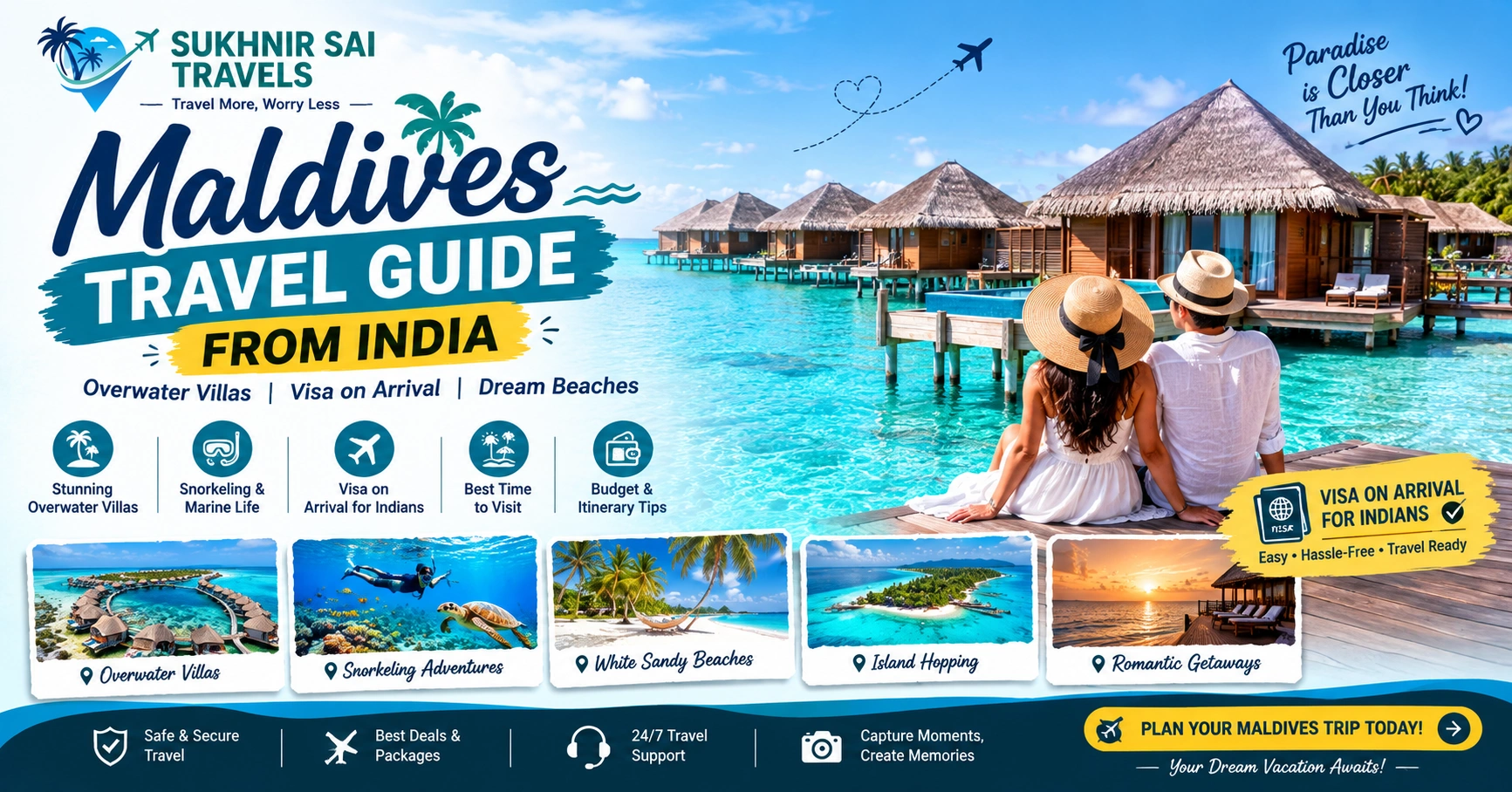
Maldives Travel Guide: Best Resorts, Cost & Visa on Arrival
The Maldives has a reputation for being an ultra-luxury, budget-breaking destination — and while the overwater villas you see on Instagram can certainly cost that much, a well-planned trip is far more accessible than most people assume. This Maldives travel guide from India covers visa-on-arrival rules, how to choose between resort islands and local islands, realistic costs at different budget levels, and the best time to go, so you can plan a trip that actually fits your budget instead of assuming the Maldives is out of reach.
If you'd rather have the resort and transfer logistics handled for you, Sukhnir Sai Travels puts together custom Maldives packages — but this guide will get you 90% of the way there even if you're booking independently.
Do Indians Need a Visa for the Maldives?
In short: No advance visa is required — Indian passport holders receive a free 30-day visa on arrival at Velana International Airport, provided they meet basic entry requirements.
This is one of the biggest reasons the Maldives is easier to plan than it looks. On arrival, immigration will typically ask for a valid passport (at least 6 months validity), proof of onward/return travel, and confirmed accommodation booking for your stay. There's no advance application, no fee, and no online form to fill out beforehand — you simply land, go through immigration, and you're free to head to your resort or guesthouse.
Resort Island vs Local Island: Which Should You Choose?
In short: Resort islands offer the classic all-inclusive Maldives experience at a higher price, while local islands (like Maafushi) let you experience the same turquoise water at a fraction of the cost.
Resort Islands
This is the Maldives most people picture — a single resort occupying an entire private island, with overwater villas, included meals, and water sports right off your deck. Prices here range from moderate to extremely high depending on the property, and most resorts require a speedboat or seaplane transfer from the airport, which adds to the overall cost.
Local Islands (Guesthouse Islands)
Islands like Maafushi, Thulusdhoo, and Guraidhoo have inhabited local communities with guesthouses, budget-friendly restaurants, and access to the same reefs and sandbanks as the resorts nearby. "Bikini beaches" on these islands allow swimwear (outside of which local dress norms apply, since these are Muslim communities), and day trips to nearby sandbanks or snorkelling spots are affordable and easy to arrange. This route can bring a Maldives trip down to a fraction of the resort-island cost while still delivering the same iconic water and beaches.
Many first-time visitors now do a hybrid trip — a couple of nights on a local island to keep costs down, followed by one or two nights at a resort for the classic overwater experience.
Best Time to Visit the Maldives from India
In short: November to April is the dry season and the most popular time to visit, though the Maldives is a year-round destination with warm weather throughout.
The Maldives sits close to the equator, so temperatures stay warm all year (typically 26-32°C). The dry season, from November to April, offers the calmest seas and least rainfall, making it ideal for diving, snorkelling, and island-hopping. The wet season (May to October) sees more rain and occasional rough seas, but also lower prices and fewer crowds — and since most rain comes in short, heavy bursts rather than all-day downpours, it's still a workable time to visit if you're budget-conscious.
Best Maldives Itinerary from India (5-6 Days)
In short: 5-6 days is enough for a relaxed trip that balances beach time with at least one or two activities like snorkelling or a sunset cruise, without needing to rush.
Day 1 — Arrival & Transfer Land at Velana International Airport, clear visa-on-arrival immigration, and transfer to your resort or local island guesthouse by speedboat, seaplane, or ferry depending on distance.
Day 2 — Settle In & Snorkelling Spend the day getting oriented, relaxing on the beach, and taking your first snorkelling trip to see the reef just offshore.
Day 3 — Island Hopping or Sandbank Trip Take a day trip to a nearby sandbank or uninhabited island — a classic Maldives experience of standing on a patch of white sand with nothing but ocean around you.
Day 4 — Water Activities Try a dolphin cruise, jet skiing, or a introductory scuba dive if you're not already certified. Many resorts and guesthouses on local islands offer beginner dive packages.
Day 5 — Relax & Explore Local Culture If you're on a local island, spend time exploring the small town, trying local Maldivian cuisine, and visiting the local market. On a resort island, this is typically a free day for spa treatments or simply relaxing.
Day 6 — Departure Transfer back to the airport for your flight home. Since most flights connect through Male, build in a buffer for transfer timing, especially if you're coming from a resort further from the airport.
How Much Does a Maldives Trip from India Cost?
In short: A local-island trip can be done for around ₹40,000-₹65,000 per person for 5 days, while a resort-island trip typically starts from ₹90,000 and can go well beyond ₹2,00,000 depending on the property.
Budget (local island) breakdown, per person:
- Flights (India to Male, return): ₹18,000 – ₹28,000
- Guesthouse (4-5 nights): ₹8,000 – ₹15,000
- Local ferry/speedboat transfers: ₹2,000 – ₹4,000
- Food & day trips (snorkelling, sandbank visits): ₹8,000 – ₹12,000
Mid-range resort island, per person (based on double occupancy):
- Flights: ₹18,000 – ₹28,000
- Resort (4-5 nights, all-inclusive or half-board): ₹60,000 – ₹1,20,000+
- Speedboat/seaplane transfer: ₹8,000 – ₹25,000 depending on distance
The transfer cost is often the most overlooked line item — resorts far from Male require seaplane transfers, which can add significantly to the total, so it's worth factoring this in before comparing resort prices.
Best Resorts and Areas for Different Budgets
In short: North and South Male Atoll resorts are closest to the airport and most budget-friendly, while further atolls like Baa or Addu offer more seclusion at a higher transfer cost.
For travellers who want to minimise transfer time and cost, resorts in North or South Male Atoll are the most practical choice, often reachable by speedboat in under an hour. If budget isn't the main constraint and seclusion is the priority, atolls like Baa (a UNESCO Biosphere Reserve, great for diving) or the more remote Addu Atoll offer a quieter, more exclusive experience — but expect seaplane transfers that can cost as much as a night's stay elsewhere. For first-time visitors testing whether the Maldives lives up to the hype, a Male Atoll property is usually the more sensible starting point.
Food in the Maldives
In short: Fresh seafood, coconut, and rice form the base of Maldivian cuisine, and most resorts also offer international buffets alongside local dishes.
Traditional Maldivian food centres around tuna, coconut, and rice — try mas huni (a shredded tuna, coconut, and onion breakfast dish) or garudhiya (a light fish broth soup) if you get the chance on a local island. Resort islands typically run international buffets covering a wide range of cuisines, so dietary preferences are rarely an issue, though vegetarian travellers should double-check menu options in advance on smaller local-island guesthouses.
Getting to the Maldives from India
In short: Direct flights connect Male to several Indian cities including Delhi, Mumbai, Bengaluru, Chennai, Kochi, and Thiruvananthapuram, with flight times ranging from just over an hour to around 4 hours.
Kochi and Thiruvananthapuram offer some of the shortest flight times to Male, often under 90 minutes, making South India a particularly convenient departure point. From Delhi or Mumbai, expect a flight of roughly 4-4.5 hours, either direct or with a short layover. Because the Maldives is so close to South India, it's increasingly popular as a long-weekend trip for travellers based in Bengaluru, Chennai, or Kochi, rather than requiring a full week off work.
Diving and Snorkelling in the Maldives
In short: The Maldives is one of the world's top diving destinations, with excellent visibility, coral reefs, and the chance to see manta rays and whale sharks in certain atolls.
Even non-divers can get a strong taste of the underwater world here through snorkelling alone — house reefs at many resorts start just a few metres from the shore. For certified divers, Baa Atoll (especially Hanifaru Bay) is famous for seasonal manta ray and whale shark aggregations, typically between May and November, while South Ari Atoll is known for more consistent whale shark sightings year-round. If you're not yet certified, most resorts and several local-island dive centres offer a beginner "discover scuba" session that doesn't require a full certification course, giving you a guided shallow dive to see the reef up close.
Is the Maldives Good for Honeymoons and Couples?
In short: Yes — the Maldives remains one of the most popular honeymoon destinations for Indian couples, largely due to its overwater villas, privacy, and all-inclusive resort packages designed specifically around couples.
Many resorts offer honeymoon-specific packages that include private dinners on the beach, couples' spa treatments, and sometimes a complimentary room upgrade if you mention the occasion at the time of booking. If budget is a concern, note that honeymoon packages are usually built around resort-island stays — couples looking for a similar romantic experience at a lower price point can consider a private guesthouse on a quieter local island paired with a single splurge night at a resort for the classic overwater villa experience.
Maldives vs Other Beach Destinations from India
In short: Compared to Bali, Thailand, or Seychelles, the Maldives offers the shortest flight time from South India and arguably the most iconic overwater-villa experience, though it comes at a higher cost unless you opt for local islands.
Bali and Thailand offer a broader mix of culture, nightlife, and adventure activities alongside their beaches, generally at a lower cost than a Maldives resort stay. Seychelles is closer in style and price point to the Maldives but has fewer flight connections from India. For travellers whose primary goal is a pure beach-and-water experience with minimal sightseeing, the Maldives remains hard to beat — especially now that local-island stays have made it accessible beyond the ultra-luxury bracket it's traditionally associated with.
Practical Tips for Indian Travellers
- Currency: The Maldivian Rufiyaa is the local currency, but US Dollars are widely accepted, especially at resorts — carrying some USD cash is useful for tipping and small local-island purchases.
- Alcohol: Alcohol is only available on resort islands and licensed floating bars — it is not sold or served on local islands due to Islamic dress and conduct norms.
- Dress code: Bikinis and swimwear are fine on resort islands and designated "bikini beaches" on local islands, but modest dress is expected elsewhere on local islands.
- Connectivity: Local SIM cards are available at the airport; resort Wi-Fi is usually included but can be inconsistent on remote islands.
- Transfers: Always confirm your transfer type (speedboat, ferry, or seaplane) when booking — this affects both cost and how much daylight you'll need for arrival.
Frequently Asked Questions
Do Indians need a visa for the Maldives? No advance visa is needed. Indian travellers receive a free 30-day visa on arrival, provided they have a valid passport, return ticket, and confirmed accommodation.
Is the Maldives expensive for Indian tourists? It can be, if you stick to resort islands, but local-island guesthouses make the Maldives accessible on a moderate budget as well.
What is the best time to visit the Maldives from India? November to April is the dry season and most popular, though the Maldives is a year-round destination.
How many days are enough for a Maldives trip? 5-6 days strikes a good balance between relaxation and activities without feeling rushed.
Can I visit local islands and resort islands in the same trip? Yes, a hybrid trip combining a few nights on a local island with one or two nights at a resort is an increasingly popular way to balance cost and experience.
Is alcohol available in the Maldives? Only on resort islands and licensed floating bars — not on local islands.
What should I pack for the Maldives? Reef-safe sunscreen, swimwear, light breathable clothing, and a modest cover-up for local islands are the essentials.
How do I get from the airport to my resort? Depending on distance, transfers are by speedboat (nearby resorts), ferry (local islands), or seaplane (remote resorts).
Is the Maldives good for solo travellers? Yes, though it's traditionally marketed as a honeymoon destination, local-island guesthouses have made solo and budget travel increasingly common.
Should I book a Maldives package or plan independently? Both work — independent booking gives more control over local-island stays, while a package simplifies resort bookings and transfers. Sukhnir Sai Travels offers customisable Maldives packages that combine the two.
Planning Your Maldives Trip From India
The Maldives doesn't have to mean a five-figure overwater villa — between visa-free entry, budget-friendly local islands, and a wide spread of resort categories, there's a version of this trip for nearly every budget. Whether you're chasing the classic honeymoon-brochure experience or a more affordable island-hopping trip, the visa-on-arrival process and short flight from India make it one of the easiest tropical getaways to plan.
If you'd like help comparing resorts, arranging transfers, or building a custom itinerary, visit Sukhnir Sai Travels or explore our International Tours packages to get started.
Related guides: Bali Travel Guide from India | Best International Honeymoon Destinations | Singapore Family Trip Guide | Thailand Backpacking Guide
