Getting a Vietnam Visa as an Indian Traveller: What the Process Actually Looks Like (2026)
Most "Vietnam visa guide" articles read like they were written once in 2019 and never touched again — generic steps, no real detail on what actually slows applications down. Since we process these applications directly for clients, here's a more honest version: what the Vietnam e-visa process for Indian travellers genuinely involves right now, which documents matter most, and where things typically go sideways if you're not paying attention.
Want this handled for you instead of doing it yourself? Sukhnir Sai Travels processes Vietnam visa applications in-house — but everything below applies whether you go through us or apply independently.
Do Indians Actually Need a Visa for Vietnam?
Yes. Unlike Nepal or Sri Lanka's more relaxed entry rules, Indian passport holders need a visa to enter Vietnam, and for the vast majority of tourist trips, that means the e-visa — an online application processed before you travel, rather than a stamp-on-arrival system. It's a fully digital process now, which is a genuine improvement over the embassy-visit requirements of a few years ago, but "digital" doesn't automatically mean "simple" if you don't know what the system is actually checking for.
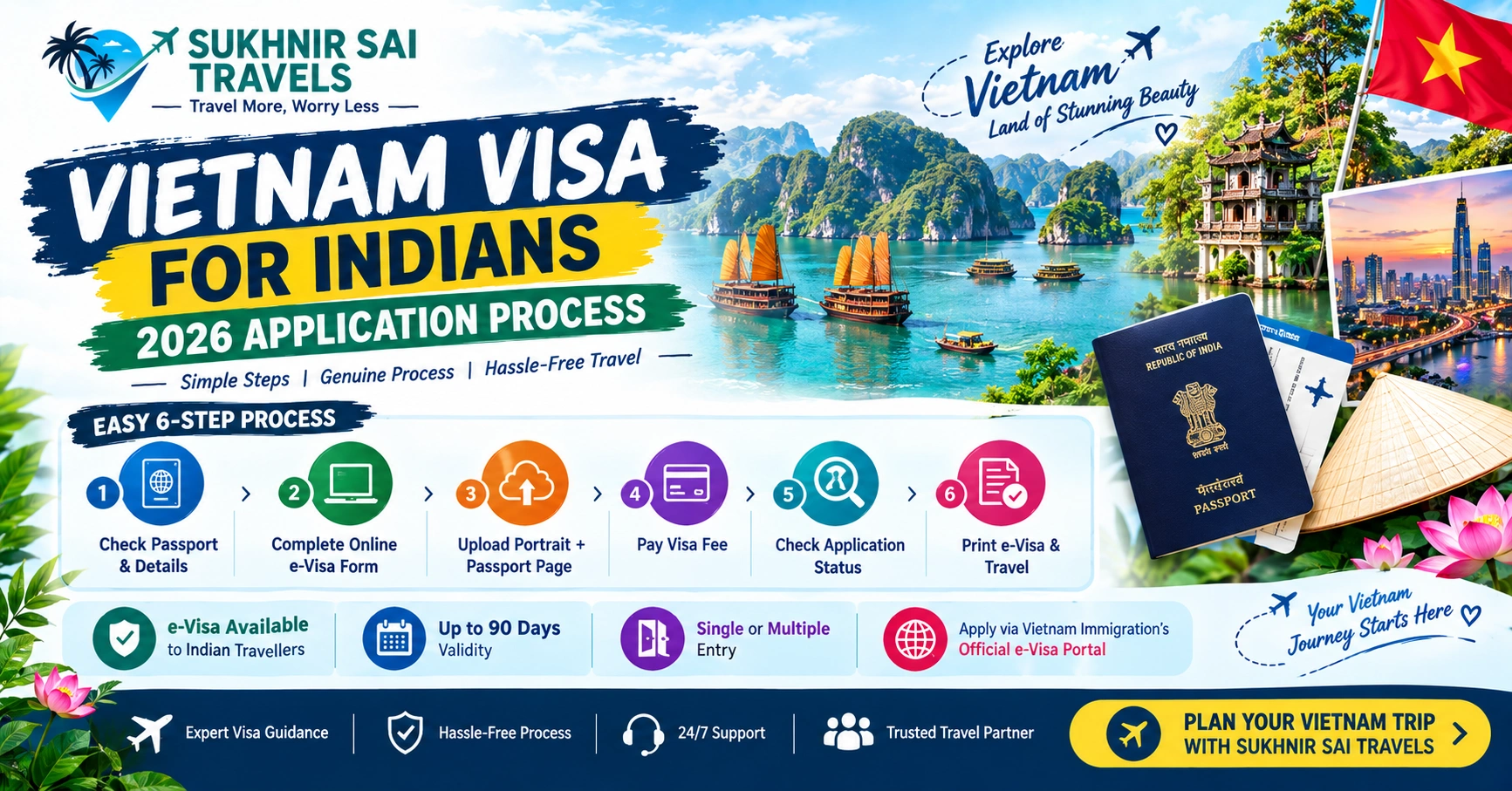
How the Vietnam e-Visa Process Works
Start on Vietnam's official immigration e-visa portal. As with most e-visa systems, there are copycat sites that charge inflated fees for the same government application — stick to the official portal or a visa agent who's transparent about which fees are government charges versus service fees.
Enter your details exactly as they appear on your passport. Vietnam's system, like most immigration portals, flags mismatches between your application and your passport data — an unusual middle name format or a transliteration difference can trigger a manual review that adds days to processing.
Upload a passport photo and passport bio-page scan. The photo needs to meet specific dimension and background requirements — not just any recent photo you have on your phone.
Select your intended port of entry. Vietnam's e-visa system asks you to specify which airport or border checkpoint you'll be entering through, and this needs to match your actual arrival point, so double-check your flight details before submitting.
Pay the visa fee online. Fees are paid directly through the portal via card. Save your payment confirmation and application code — you'll need it to check status later.
Track and download your approved visa. Processing has generally taken a handful of business days, though it can stretch longer during high-demand periods. Once approved, download and print the visa letter — Vietnamese immigration typically wants to see a physical copy alongside your passport on arrival.
What You'll Need to Have Ready
- A passport valid for at least 6 months beyond your travel dates, with at least one blank page
- A recent passport-style photograph meeting Vietnam's specific size and background requirements
- A clear scan of your passport's bio page
- Your exact port of entry and travel dates, since these are locked into the visa once issued
- A valid email address, since your approved visa is delivered digitally and you'll need to print it yourself
Unlike some visa processes, Vietnam's e-visa generally doesn't require hotel booking confirmations or return flight proof at the application stage, though it's smart to have both ready in case an immigration officer asks for them on arrival.
Where Vietnam Visa Applications Actually Go Wrong
Wrong port of entry selected. This is one of the most Vietnam-specific mistakes — travellers sometimes select an airport different from where they're actually landing, either from confusion about connecting flights or simply not reading the field carefully. This can cause real problems at immigration.
Photo doesn't meet spec. Same pattern as most e-visa systems — a photo that's too old, wrong background, or incorrectly cropped is a completely avoidable but frequent cause of delay.
Applying too close to travel dates. Vietnam's e-visa is generally faster than a full embassy visa process, but "generally faster" isn't "instant." Applying with only a couple of days' buffer leaves no room to fix an error.
Passport validity cutting it close. Less than 6 months of remaining validity from your travel date is a hard stop — check this before you even start filling out the form.
Details not matching passport exactly. A shortened name, a missing initial, a different date format — small inconsistencies that seem trivial but can trigger manual review delays.
How Long Does Processing Actually Take?
Vietnam's e-visa processing has generally run from a few business days up to around a week under normal conditions, though volume-driven slowdowns happen, particularly ahead of major travel seasons. As a practical rule, applying 2-3 weeks before your trip gives you a comfortable buffer — enough time to catch and fix a document issue without panicking about your departure date.
What Does It Cost?
The Vietnam e-visa fee is set by Vietnamese immigration authorities and paid directly through the official portal. If you're going through an agency, ask specifically what portion of the quoted fee is the government charge versus their own service fee — a legitimate agency will break this down clearly rather than quoting one bundled number.
Multiple Entry vs Single Entry: Which Do You Need?
Vietnam's e-visa system generally offers both single-entry and multiple-entry options, and it's worth thinking through your itinerary before choosing. If your trip involves a side trip to Cambodia or Laos and a return to Vietnam afterward, a multiple-entry visa avoids the need for a fresh application. For a straightforward single-country trip, single-entry is the simpler and often cheaper choice — just make sure you're clear on which one you're actually applying for, since switching after the fact isn't straightforward.
A Genuinely Useful Habit: Screenshot Everything
This sounds almost too simple to be worth mentioning, but it consistently saves people real stress: screenshot every confirmation screen during the application — the submission confirmation, the payment receipt, the application tracking number. If the portal has a glitch or your status page doesn't update as expected, having your own records means you're not stuck trying to prove you actually applied.
What Immigration Actually Checks on Arrival
Even with an approved e-visa, Vietnamese immigration officers at the airport will typically check your printed visa letter alongside your physical passport, and may ask about your accommodation or onward travel plans, particularly if anything on your application looked unusual during review. Having a printed hotel confirmation and a rough itinerary ready — even though it wasn't required at the application stage — makes this interaction faster and smoother.
Applying as a Family or Group
Each traveller, including children, needs their own individual Vietnam e-visa application with their own passport and photo — there's no combined family application, even for infants. If you're applying for a group, it helps to submit applications around the same time with consistent trip details (same arrival date, same port of entry) since inconsistencies between group members' applications can sometimes prompt additional scrutiny. Double-check that every child's passport also clears the 6-month validity requirement independently — this is a surprisingly common oversight when parents are focused on their own paperwork and assume a child's passport is automatically fine.
Vietnam vs Thailand: How the Visa Processes Actually Compare
If you're weighing a Vietnam trip against Thailand, the visa processes are broadly similar in structure — both are online e-visa systems with comparable document requirements — but Vietnam's port-of-entry requirement is a detail Thailand's process doesn't really have in the same way, making it one of the more distinctly Vietnam-specific things to get right. Processing timeframes for both tend to land in a similar range under normal conditions. If your trip includes both countries, it's worth applying for each visa separately with enough buffer for both, rather than assuming one approval speeds up the other — they're entirely independent systems.
What to Do If Your Application Gets Rejected
A rejection isn't necessarily the end of your travel plans, but it does mean stopping to understand exactly why before reapplying. Common, fixable reasons include a photo that didn't meet spec, a document scan that was unclear or cropped incorrectly, or a data mismatch between your application and passport. Genuinely more serious issues — passport validity problems, for instance — need to be resolved before any resubmission makes sense. If you're unsure why an application was rejected, a visa agent who handles Vietnam applications regularly can often read between the lines of a rejection notice faster than you'd manage on your own first attempt.
E-Visa, Visa-on-Arrival, or Embassy Visa: Clearing Up the Confusion
A lot of outdated information online still references Vietnam's older visa-on-arrival system, which required a pre-approval letter separate from the visa stamp you'd get at the airport. That system has largely been phased out in favor of the more straightforward e-visa for most tourist travel, which is applied for and fully approved before you fly, with nothing further to process on arrival beyond a standard immigration check. If you come across guidance describing visa-on-arrival "approval letters," it's likely outdated — the e-visa route covers the vast majority of Indian tourist trips to Vietnam today, and it's worth double-checking any source's publish date before following visa advice that might no longer reflect the current system.
Seasonal Timing: When Processing Tends to Slow Down
Like most e-visa systems, Vietnam's sees a jump in application volume ahead of peak Indian travel periods — major holidays and the cooler November-to-April window when Vietnam's weather is at its most pleasant. If you're applying during these peak windows, stretching your buffer from the standard 2-3 weeks to closer to a month gives meaningfully more breathing room. Outside peak season, processing tends to move a bit more predictably, though building in some buffer remains sensible regardless of timing.
A Few Misconceptions Worth Clearing Up
"E-visa means visa-free." It doesn't — you still need to apply and get approved before travel, just entirely online rather than through an embassy visit.
"Any recent photo will work." Vietnam's system has specific dimension and background requirements, and a photo that doesn't match them is one of the most common reasons for delay.
"The port of entry field doesn't really matter." It absolutely does — your visa is tied to a specific entry point, and a mismatch with your actual arrival airport can cause real problems at immigration.
"Processing is instant." It's faster than older embassy-based processes, but it's not immediate — treat the stated processing window as a minimum, not a guarantee.
Frequently Asked Questions
Do Indian citizens need a visa to enter Vietnam?
Yes, Indian passport holders need a visa, and the e-visa is the standard route for most tourist trips.
How long does the Vietnam e-visa take to process?
Generally a few business days to around a week, though applying 2-3 weeks ahead of travel is a safer buffer.
What's the most common mistake on Vietnam visa applications?
Selecting the wrong port of entry or submitting a photo that doesn't meet the required specifications are two of the most frequent, entirely avoidable issues.
Can I apply for a Vietnam e-visa without help from an agency?
Yes, the official portal is designed for self-service applications. An agency mainly helps by catching errors before submission and handling document formatting.
Do I need proof of hotel booking for the Vietnam e-visa application?
It's generally not required at the application stage, but it's smart to have it ready in case immigration asks on arrival.
What happens if I choose the wrong port of entry?
This can cause complications at immigration, since your visa is tied to a specific entry point — it's worth reapplying or contacting the portal's support if you catch the error before travel.
Is a multiple-entry Vietnam visa worth it?
Only if your itinerary includes leaving and re-entering Vietnam, such as a side trip to a neighbouring country — otherwise a single-entry visa is simpler and usually cheaper.
How much passport validity do I need for Vietnam?
At least 6 months remaining beyond your travel dates.
What should I do if my Vietnam visa application is delayed?
Check your application status using your tracking code, and if there's no update near your expected processing window, contact the portal's support or your visa agent for a status check.
Should I book flights before or after my visa is approved?
It's safer to have your visa well into approval, or at least confirmed as low-risk, before locking in non-refundable flights, since your port of entry needs to match your actual arrival details.
Is Vietnam's visa-on-arrival system still available for Indians?
The older visa-on-arrival approval-letter system has largely been replaced by the e-visa for most tourist travel — check current guidance rather than relying on older articles describing that process.
Can I change my port of entry after my Vietnam visa is approved?
Generally no — if your travel plans change and your entry point no longer matches your approved visa, you'll likely need to reapply rather than amend the existing approval.
Do I need a return ticket to apply for a Vietnam e-visa?
It's not typically required at the application stage, though having one ready is smart in case immigration asks for it on arrival.
Applying for Your Vietnam Visa: The Short Version
The Vietnam e-visa system genuinely is more convenient than it used to be, but convenience only helps if the details are right the first time. Get your port of entry correct, your photo to spec, your passport validity checked, and apply with a reasonable buffer — that alone avoids the vast majority of delays we see in applications that come to us after already running into trouble elsewhere. Whether you're travelling solo, as a couple, or coordinating visas for an entire family, the same basic discipline around accurate details and early applications makes the difference between a smooth process and a stressful one right before departure.
If you'd rather have your application handled directly, apply for your Vietnam visa with Sukhnir Sai Travels — we process applications in-house and flag issues before they turn into delays.
Keep exploring: Vietnam Travel Guide from India | Thailand Visa for Indians | International Travel Visa Documents Checklist | Dubai Visa for Indian
