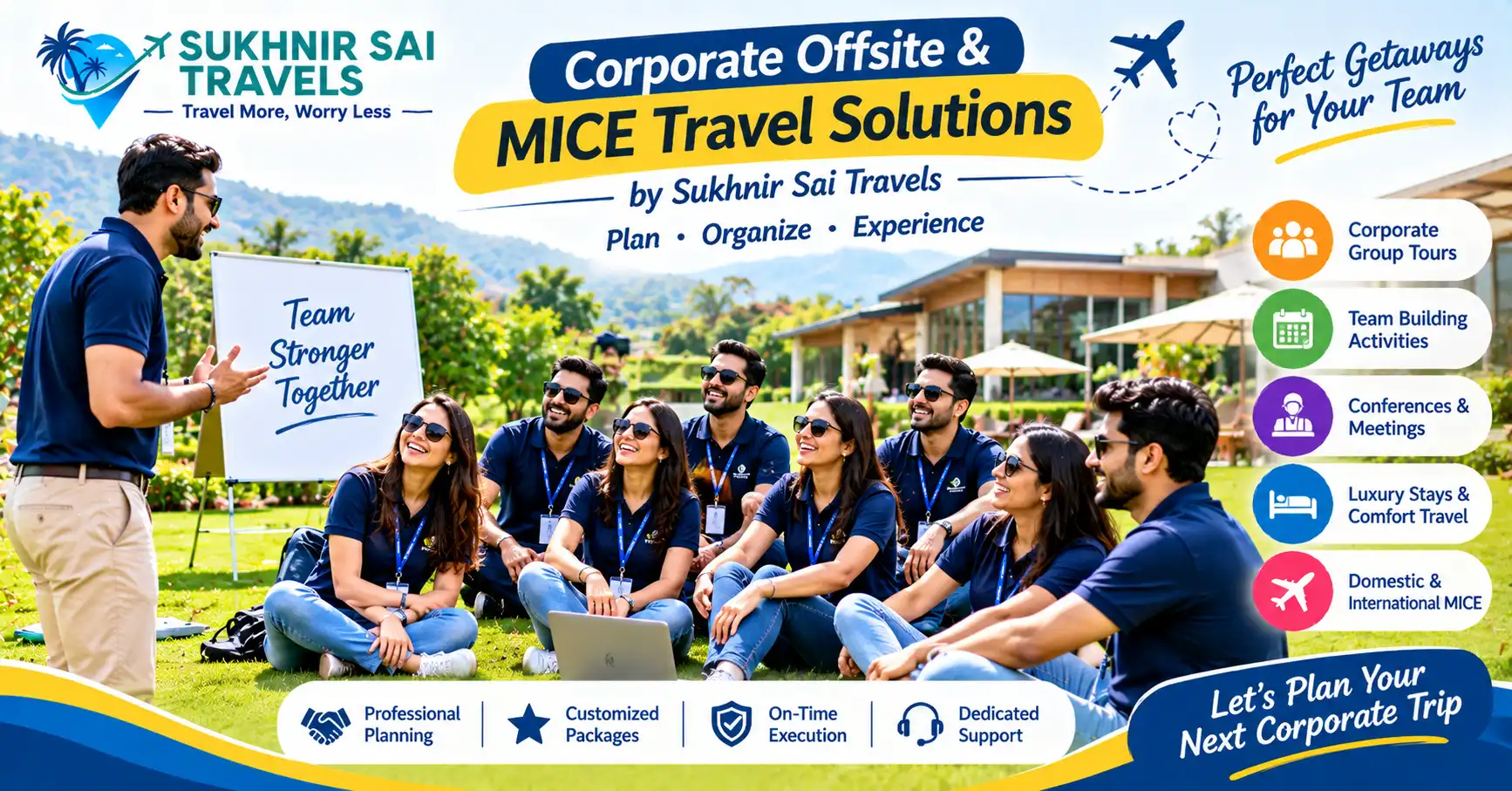
MICE Travel Company in Delhi: How to Choose the Right Partner for Your Corporate Trip
Last updated: November 2026 | Sukhnir Sai Travels Corporate Travel Desk
That's the job a good MICE travel company in Delhi is meant to take off your plate. MICE stands for Meetings, Incentives, Conferences and Exhibitions, and it covers almost any trip where a company moves a group of people for business or reward. But the label tells you very little about quality. Some agencies are excellent at 15-person leadership retreats and struggle with 150-person conferences, and others are the reverse. Choosing the right partner means understanding what you actually need and what a general travel agency in Delhi can and can't do for you.
Quick answer: A MICE travel company in Delhi plans and manages corporate group travel, including meetings, incentive trips, conferences and exhibitions, covering flights or coaches, hotels, venues, meals, activities and on-ground coordination. A good one gives you an itemised written quote, a named coordinator, backup plans, consolidated invoicing and honest advice about whether your group size and budget fit. Choose by event type and group size, not by the biggest advertised name.
What MICE Actually Means
The acronym gets used loosely, so here's what each part usually involves in practice.
Meetings. Internal gatherings held away from the office, such as leadership retreats, strategy sessions, training programmes and client meetings. The priority is a good venue, reliable logistics and a distraction-free setting.
Incentives. Reward trips for high-performing employees, dealers or channel partners. Here the experience matters more than the agenda, so destination, hotel quality and memorable activities carry the weight.
Conferences. Larger gatherings with speakers, sessions and often external attendees. These need venue capacity, audio-visual support, registration flow and careful timing.
Exhibitions. Trade shows and expos where a company sets up a stand or sends a team. Logistics around travel, accommodation and equipment drive the plan.
Many corporate trips blend several of these. A company might hold a two-day conference followed by an incentive evening, which is why a flexible partner matters more than a rigid package.
MICE Travel Company vs. General Travel Agency in Delhi
Most people searching for a travel agency in Delhi are planning a family holiday or a group trip, and a good agency handles those well. Corporate travel adds requirements that leisure planning rarely has:
| General travel agency | MICE-focused travel company | |
|---|---|---|
| Typical client | Families, couples, friends | Companies, associations, institutions |
| Group size | A few to a few dozen | Dozens to hundreds |
| Pricing | Per person, package style | Per head with headcount assumptions and itemised budgets |
| Paperwork | Booking confirmations | GST invoices, consolidated billing, approvals |
| Agenda | Sightseeing | Sessions, venues, AV, team activities |
| Flexibility | Pick from options | Built around the company's brief |
| Support | Trip contact | Dedicated coordinator on site |
The overlap is real. Many leisure agencies, especially boutique ones, plan smaller corporate offsites and incentive trips very well. The key is matching the agency's strengths to your event. If you're organising a 30-person offsite, a boutique team can often give you more attention than a large operator. If you're running a 300-person conference with exhibition space, you'll want a firm with proven experience at that scale. A trustworthy partner will tell you which category you fall into.
For a broader look at vetting any agency, our guide to how to pick the right travel agency in Delhi covers the checks that apply to corporate and leisure bookings alike.
What a MICE Travel Company in Delhi Typically Handles
Services vary, but a capable partner usually covers most of the following:
- Destination and venue selection, matched to your objectives, budget, season and group profile.
- Flights, trains or coach transport, including group bookings and airport transfers.
- Accommodation, with room blocks, room-type allocation and rooming lists.
- Meeting and conference venues, including seating layouts, AV equipment and breakout spaces.
- Meals and catering, with dietary preferences handled in advance.
- Team-building and incentive activities, from outdoor adventures to cultural experiences.
- Visa and documentation support for international events.
- On-ground coordination, including registration desks, welcome kits and a team on site.
- Budgeting and invoicing, with itemised costs and consolidated GST invoices.
- Contingency planning, covering weather, delays, venue changes and last-minute headcount shifts.
Popular Destinations for Corporate Trips from Delhi
The right destination depends on the purpose, the budget and how much time people can spare. Here's how the most common options tend to fit.
Domestic
Jaipur, Udaipur and Rajasthan. Palace hotels, heritage venues and gala-dinner settings make Rajasthan a staple for incentive trips and leadership retreats. Winter offers the most comfortable weather.
Goa. A long-time favourite for team outings and conferences, with beach venues, large resorts and good air connectivity. Monsoon brings lower rates but changes what's practical.
Himachal and Uttarakhand. Rishikesh, Shimla, Manali and the Corbett region suit retreats, adventure-based team building and shorter trips from Delhi. See our list of weekend trips from Delhi within 300 km for options that work for a short offsite.
Kashmir. Increasingly considered for incentive trips, though timing is crucial. Read the best time to visit Kashmir before fixing dates.
Kerala. Backwaters and resorts suit slower, relaxation-focused incentive programmes.
International
Thailand. Direct flights, a wide choice of hotels and easy logistics make Thailand one of the most popular overseas incentive destinations from Delhi. Our Thailand backpacking guide and Thailand visa guide for Indians explain the destination and entry basics.
Bali. A favourite for reward trips thanks to its resorts, spa culture and activities. See our Bali travel guide from India.
Singapore and Malaysia. Well suited to conferences and structured programmes because of the infrastructure, safety and ease of movement. Our Singapore family trip guide shows how the city works for groups.
Dubai. Strong for conferences, exhibitions and shorter incentive trips, with excellent venues and connectivity.
Nepal and Sri Lanka. Budget-friendly options for smaller teams, with straightforward entry rules for Indian travellers. See our Nepal trip guide.
If the budget per head is the main constraint, our guide to the cheapest international trips from India under ₹30,000 shows what's realistic for smaller incentive budgets.
How Much Does Corporate Group Travel Cost?
MICE budgets vary widely because every brief is different. The ranges below are rough planning figures for a mid-range programme, not quotes, and they exclude flights unless stated.
| Event type | Typical duration | Approx. cost per head (excl. flights) |
|---|---|---|
| Domestic offsite near Delhi | 2 days / 1 night | ₹5,000-₹14,000 |
| Domestic retreat (Rajasthan, Himachal, Goa) | 3 days / 2 nights | ₹10,000-₹28,000 |
| Domestic incentive trip, premium | 3-4 days | ₹25,000-₹60,000 |
| International incentive (Thailand, Bali) | 4-5 days | ₹35,000-₹75,000 |
| Conference with venue and stay | 2-3 days | Varies widely by venue and AV needs |
What drives the cost most:
- Headcount. Larger groups usually reduce the per-person rate for transport and venues, but need more coordination.
- Hotel category and location. The single biggest lever.
- Season. Peak weeks around holidays, festivals and wedding season can raise rates sharply.
- Venue and AV. Conference rooms, stages and technical support add significant cost.
- Activities. Team-building and gala events vary from simple to elaborate.
- Flights and transfers. Group air fares and private coaches change the total considerably.
- Lead time. Booking early generally secures better rates and availability.
Give the planner a budget range in your first conversation. A good one will tell you honestly what it can and can't buy, which is far more useful than a flattering quote that collapses later.
How to Brief a MICE Travel Company
Quality in, quality out. A clear brief gets you a sharper proposal and fewer rounds of revisions. Share:
1. Objective. Training, reward, planning, client engagement or celebration. The purpose shapes everything else.
2. Headcount. An estimate plus how likely it is to change. Also share the mix, for example senior leaders, junior staff, spouses or external guests.
3. Dates and flexibility. Fixed or movable, and whether you must avoid specific weeks.
4. Budget. A per-head or total figure, and whether it includes flights.
5. Venue and agenda needs. Number of sessions, seating style, AV requirements, breakout rooms, and how much free time to build in.
6. Preferences and restrictions. Dietary needs, accessibility requirements, company policies on alcohol, travel class or hotel category.
7. Approval and invoicing process. Who signs off, what documents finance needs, and whether GST invoices must be in a particular format.
8. Past experiences. What worked and what didn't in earlier events. This often reveals more than a long wish list.
What to Check Before You Sign
1. Ask for an itemised quote. Flights, hotel names, room types, venue costs, meals, transport, activities, staffing and taxes should each appear on a separate line.
2. Check exclusions. AV equipment, tips, entertainment, permits and insurance are common extras.
3. Request references or examples. Ask for similar events the company has handled and how they went. A small boutique team may not have a huge portfolio, but it should be able to describe comparable work honestly.
4. Confirm who will be on site. A named coordinator with a working number, available throughout the event.
5. Understand headcount rules. Most contracts set a minimum number, with rules about increases and reductions. Clarify the cut-off dates and penalties.
6. Read the cancellation and change terms. Group bookings often carry stricter conditions than individual ones. Get the schedule in writing.
7. Ask about backup plans. What happens if a flight is cancelled, a venue falls through or weather disrupts an outdoor activity?
8. Verify the business. Look for a registered business, a physical address and payment to a business account. Keep every receipt.
9. Clarify invoicing. Confirm that GST invoices, consolidated billing and any company-specific documentation are included.
10. Compare like with like. If two quotes differ, check hotel category, location, meal plan, transport type and inclusions before assuming one is overpriced.
For overseas events, review our page on the best travel agency in Delhi for international tours, and share our international travel visa documents checklist with attendees early so passports and paperwork don't become the bottleneck.
Red Flags in Corporate Travel Proposals
- A flat quote with no itemisation, making it impossible to compare or adjust.
- No named hotels or venues, only categories like "4-star in city centre."
- A proposal that arrives instantly with no questions about your objective, group or budget.
- Vague promises such as "everything arranged" with no written scope.
- Pressure to pay in full upfront to "block" rates.
- Payments requested to a personal account.
- No clear contact during the event.
- Unwillingness to discuss backup plans.
- Visa guarantees. No honest agent can promise an embassy's decision.
One of these deserves a question. Several together deserve a second quote.
What Companies in Delhi Are Asking For Right Now
Enquiry patterns and search behaviour point to a few clear shifts in corporate travel.
Shorter, more frequent offsites. Many teams prefer a one-night retreat near Delhi over a single large annual trip, especially for mid-sized teams.
Experience over luxury. Companies increasingly want activities people remember, such as cooking classes, outdoor challenges and local experiences, rather than purely upgraded hotels.
Cost control with transparency. Finance teams want per-head clarity, itemised budgets and fewer surprises.
Hybrid planning. Events that combine a working session with a short leisure window are growing, as are trips timed to extend a long weekend.
Wellness and sustainability. Interest is rising in programmes that include wellness activities, healthy menus and lower-impact choices.
Safety and duty of care. Companies ask more about vetted hotels, verified transport and support during emergencies, especially for mixed groups and women travellers.
Smaller international incentives. Short, well-run trips to Thailand, Bali or Singapore are replacing longer, costlier programmes.
A Sample 2-Day Offsite Near Delhi
This is an illustration of pacing, not a fixed package, for a team of about 30 people heading to the Rishikesh or Neemrana region.
Day 1: Depart Delhi by 7:30 am in two coaches, arrive by late morning, hold a working session before lunch, then a relaxed afternoon with a short team activity. Evening: an informal dinner with no agenda.
Day 2: A short morning session or outdoor challenge, a leisurely brunch, a closing discussion, checkout, and a return that lands in Delhi before the evening rush.
What makes it work is what it leaves out: no back-to-back sessions, no activity forced on everyone and no late-night return. Teams usually remember the unstructured hours more than the slides, so protect them.
Ideas for Team Activities That Don't Feel Forced
- Cooking or craft sessions that mix people from different departments.
- Light outdoor challenges such as treasure hunts, nature walks or river-side games.
- Storytelling or reflection circles with simple prompts, not formal presentations.
- Local experiences, like a market visit, a heritage walk or a farm lunch.
- Optional adventure activities for those who want them, with a relaxed alternative for those who don't.
The best activities are voluntary, inclusive and short. A good planner will suggest a mix and adjust it based on your team's energy and ages.
A Sample Planning Timeline
Domestic offsite (small team): 3 to 6 weeks ahead is usually enough, longer for peak season.
Domestic conference or incentive (larger group): 8 to 12 weeks ahead, because venues and room blocks fill quickly.
International incentive or conference: 12 to 16 weeks ahead, particularly if visas are needed.
Peak periods (Diwali, Christmas-New Year, wedding season): Book earlier still, since good venues and flights go first.
A typical process: you share the brief, the agency proposes options and a budget, you refine the plan, contracts and deposits are agreed, bookings are confirmed, rooming lists and documents follow, and a final briefing happens a few days before the event.
Common Mistakes in Corporate Trip Planning
Treating headcount as fixed. Numbers change. Agree on rules for adding or dropping attendees early.
Over-scheduling. Packed agendas leave no room for networking or rest. Build in free time.
Ignoring travel time. A venue that looks close on a map may involve long, tiring transfers.
Overlooking dietary and accessibility needs. Collect these early, not on the day.
Choosing purely on price. The lowest quote often leaves out transfers, AV or meals that you then pay for separately.
Leaving visas late. International delays are the most avoidable source of stress.
Skipping the contingency conversation. Weather, delays and venue changes happen. Plan for them before they do.
How Sukhnir Sai Travels Approaches Corporate Travel
We're a Delhi-based boutique travel team, planning trips since 2019 and looking after 500+ travellers so far. For corporate groups, our approach is simple: ask good questions first, build the plan around your objective, name every hotel, itemise every cost and stay reachable throughout. We work best with offsites, retreats and incentive trips for small and mid-sized teams, and we'll tell you honestly if your event is larger or more specialised than we can serve well, rather than overpromise.
You can explore our current international trips and group tour packages from Delhi for inspiration, or contact us with a brief and we'll suggest a plan and an honest budget range.
Frequently Asked Questions
What does a MICE travel company in Delhi do? It plans and manages corporate group travel for meetings, incentives, conferences and exhibitions, covering transport, hotels, venues, meals, activities, documentation and on-ground coordination.
What does MICE stand for? Meetings, Incentives, Conferences and Exhibitions. The term covers most business-related group travel.
How is a MICE company different from a regular travel agency in Delhi? MICE-focused firms handle larger groups, itemised corporate budgets, consolidated invoicing, venue and AV arrangements and on-site coordination. Many boutique travel agencies also handle smaller offsites and incentive trips well.
How much does corporate group travel cost per person? A short domestic offsite can cost a few thousand to about ₹14,000 per head, while international incentive trips often range from ₹35,000 to ₹75,000 per head excluding flights, depending on destination, hotel and season.
How far in advance should we book a corporate trip? Small domestic offsites need around 3 to 6 weeks. Larger domestic events need 8 to 12 weeks, and international events 12 to 16 weeks, especially with visas.
Which destinations are best for a corporate offsite from Delhi? Rishikesh, Jaipur, Udaipur, Goa and the hill regions work well domestically. Thailand, Bali, Singapore and Dubai are popular overseas for incentives and conferences.
What should be included in a MICE proposal? Itemised costs, named hotels and venues, transport details, meals, activities, staffing, taxes, cancellation terms, a contingency plan and a named coordinator.
Can a MICE company handle visas for international events? Many can assist with documentation and timelines, but only the embassy or consulate makes the decision. Be wary of anyone who guarantees approval.
What happens if our headcount changes? Most contracts include rules and cut-off dates for increases and reductions. Agree on these in writing before signing.
Do you provide GST invoices for corporate bookings? Reliable agencies provide proper GST invoices and consolidated billing. Confirm the format your finance team needs before you book.
Is a boutique agency suitable for a corporate event? For small and mid-sized offsites and incentives, often yes, since you get closer attention. For very large conferences or exhibitions, choose a firm with proven experience at that scale.
How do I compare two corporate travel quotes? Match hotel category and location, room types, meal plans, transport, activities, AV and taxes. Price differences nearly always come from one of these.
The Short Version
A good MICE travel company in Delhi makes a corporate trip feel simple for you and memorable for the team. Start with a clear objective and a realistic budget, ask for an itemised written proposal, check who will be on site, and make sure there's a plan for when things change. Pick a partner whose strengths match your event size, not just the loudest name.
If you're planning an offsite, incentive trip or team retreat, Sukhnir Sai Travels would be glad to help you shape it and give you an honest view of the budget.